
Instrument Integration in Laboratory Architecture: More Than Just an IT Project
Written by Mario Hoverath
Introduction
We live in a world where plug-and-play has become the standard. Today, a new printer, a headset or many other peripheral devices can often be integrated into existing IT environments within just a few minutes. Standard interfaces, open protocols and interoperable systems have long been part of our everyday reality. In the laboratory, however, the situation is often different. Even today, integrating new analytical instruments remains one of the most time-consuming tasks in digitization projects although promising approaches such as SiLA (Standardization in Lab Automation), AnIML (Analytical Information Markup Language) and other standards have existed for years. In many laboratories, we still encounter processes in which analytical data is exported from instruments, transferred manually or maintained redundantly and in isolation across multiple systems. These data silos are a high risk for data transfer errors, are very time-consuming, make it difficult to ensure traceability of the raw data, and limit the ability to evaluate and analyze the data. Nevertheless, these workflows have often established over many years and appear to be reliable. So why is the successful integration of instruments in the laboratory still not the norm? And what impact does this have on digital transformation in companies?
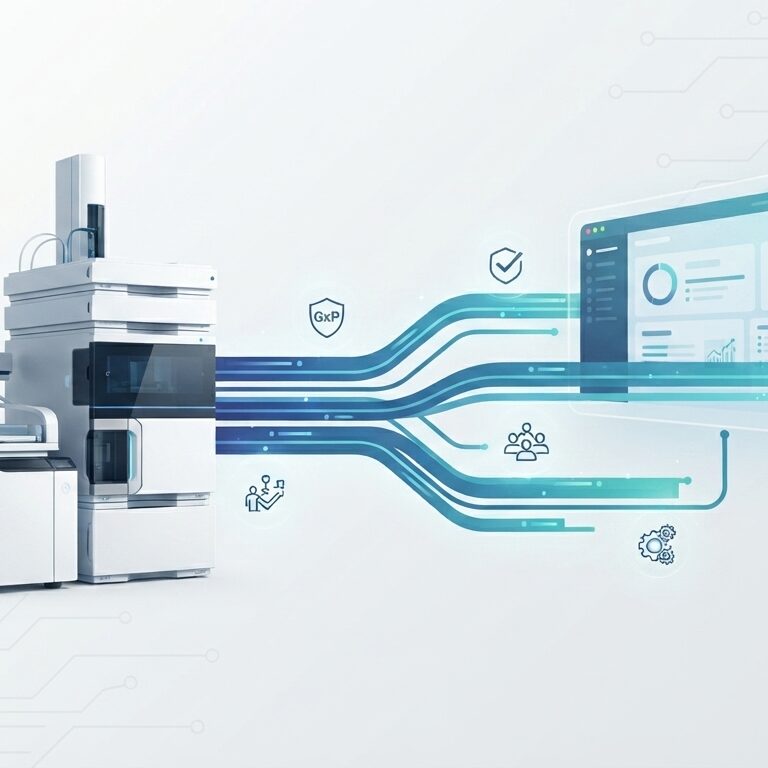
When we talk about instrument integration, we mean the seamless connection of analytical instruments and measuring instruments to central systems - in particular, LIMS (Laboratory Information Management Systems), ELN (Electronic Lab Notebook), MES (Manufacturing Execution System) or ERP (Enterprise Resource Planning) systems - with the goal of exchanging data automatically, securely and in real time between the involved systems via instruments interfaces. The technical options for instrument integration depend strongly on the specific instruments being connected. They range from simple serial interfaces such as RS-232 or USB, which are mostly found in older instruments - to bidirectional REST-API interfaces over a LAN connection that enable interactive communication with the instruments. Often, an instrument is connected via specialized control software that acts as an intermediate layer between the instrument and LIMS, ELN or other quality management systems. Today, the technical aspects alone are often no longer the biggest challenge. The real complexity arises from the combination of technology, manufacturers, processes and GxP requirements.
Proprietary Solutions
Technical data transmission capabilities vary greatly depending on the manufacturer and are not standardized. Historically, each manufacturer has individually developed its own communication protocols, data structures and software platforms. Poorly documented or undocumented interfaces, as well as any unique features in the IT infrastructure, further complicate instrument integration. While there are important initiatives to standardize interfaces - such as SiLA and AnIML, which serve as examples of standard protocols and standard data formats, respectively - they have not yet become widely adopted in practice. This is due, in part, to the fact that many older instruments still in use were developed before these standards existed and many manufacturers continue to rely on their proprietary solutions.
Different Data Models
In addition to the technical transfer of data, another challenge is its interpretation. The question is not only “How do we transfer data?” but also “How do we ensure that the data retains the same meaning in the target system?” Simply transferring a measured value is usually not enough. In addition, methods and parameters, units, sample references, measurement information (such as user and measurement time), instrument status information, error messages and other metadata must be transferred. In bidirectional interfaces, measurement sequences, worklists and work instructions are also transmitted to the instrument. The exchange of information usually requires appropriate data mapping between the instrument or control software and the LIMS. A comprehensive concept for master data management and, where necessary, efforts to harmonize master data are therefore absolutely essential.
GxP and Validation
In a regulated environment, additional challenges arise when it comes to instrument integration. This aspect becomes particularly important in view of increasing regulatory requirements for data integrity. Terms such as ALCOA+, FDA 21 CFR Part 11 or EU GMP Annex 11 are part of every digitalization project in a regulated environment. However, the question is always the same: Can we demonstrate that our data is complete, accurate, traceable and reliable? In the GxP environment, the path to a validated interface between an analytical instrument and, for example, a LIMS is defined by a structured validation process based on the GAMP 5 guidelines. The goal is to provide complete, tamper-proof evidence that data is transferred with integrity and traceability. For an interface, GAMP Category 4 or 5 is typically used as the basis. This means the software used is offered by the manufacturer as standard software or driver software and configured or programmed according to the user’s requirements. The focus is then on functional tests (OQ, PQ) to ensure error-free data mapping. In some specific cases - for example, when dealing with an older instrument for which no suitable standard connectors are available - it may be necessary to program a custom interface. Validation must cover the entire lifecycle of the interface software. In other words, the effort involved in such cases is correspondingly high.
Organizational Factors
Manufacturers typically supply a functional instrument and, if necessary, the required control software. LIMS providers supply out-of-the-box or customized interfaces. Responsibility for integrating the instrument into the enterprise landscape usually lies with the operator, with the result that LIMS providers, instrument manufacturers, IT, QA and the business unit often operate within different areas of responsibility, without anyone taking overall responsibility for end-to-end integration. Organizational factors can thus complicate instrument integration in addition to the technical challenges.
The complexity of integration is often a problem for the entire system. The lack of standardized protocols, interfaces and data models, as well as issues with governance and collaboration, are the biggest gaps. The complexity of device integration and the resulting time and resource requirements is often underestimated and can lead to project delays or budget overruns. Furthermore, instrument integration is frequently planned as a subproject of a LIMS implementation or replacement. As a result, instrument integration is often placed at the end of the project plan. If the LIMS configuration is delayed, instrument integration shifts onto the critical path. The laboratory goes live with incomplete automation or, in the worst case, without any automation at all.
Advantages of successful Instrument Integration
Instrument integration is often discussed in the context of automation, time savings or the reduction of manual tasks. These are indeed important benefits. However, this perspective does not go far enough, especially in GxP-regulated industries such as pharmaceuticals, biotechnology and medical technology. This is because instrument integration is not primarily an IT issue, nor is it merely an efficiency project. It is a central component of compliance, data integrity and sustainable digitalization.
Improved Data Quality
The direct transmission of measurement results eliminates the need for manual data entry. This reduces data entry errors and increases data reliability. This is precisely where instrument integration delivers its greatest benefit. Data no longer needs to be recorded multiple times or transferred between different systems. The amount of manual intervention is reduced and the risk of errors and deviations decreases significantly.
More efficient processes
Automated workflows speed up the entire analysis process. Employees can focus more on interpreting results and valuable activities. Ideally, lab employees can focus entirely on their core work: analyzing samples at their lab workplaces. Interaction with a LIMS at a computer workstation is minimal and limited to planning analytical activities or managing special cases in an exception-based process.
Compliance
Integrated systems facilitate compliance with regulatory requirements such as GxP, FDA 21 CFR Part 11 or ISO standards. Every data change can be documented in a traceable manner. Anyone who has ever assisted with a regulatory inspection knows the challenge: information must be readily available, relationships must be presented in a traceable manner and data sources must leave no questions open. In an integrated system landscape, instrument data, audit trails, user activities and process steps can be presented with significantly higher transparency than in an environment based on manual interfaces. This substantially reduces the effort required for reviews, audits and inspections.
Real-Time transparency
Decision-makers have immediate access to up-to-date laboratory and production data. This enables faster responses to deviations and more well-informed decisions.
Scalability
New instruments can be integrated more easily into existing processes. This lays the foundation for future growth and further digitalization initiatives.
Success factors for integration projects
Instrument Integration projects are less of a technical challenge and more of an organizational one. Successful projects are often characterized by the following factors:
- Clear definition of interface requirements
- Standardized interfaces and data models
- Early involvement of laboratory, IT, and quality teams
- A long-term integration strategy rather than individual, point solutions
It is crucial not to view instrument integration as an isolated IT project, but rather as part of a comprehensive digitalization strategy. Modern integration platforms, cloud technologies and standardized communication protocols now make it significantly easier to connect instruments than it was just a few years ago.
Companies that invest in instrument integration early on lay the foundation for:
- Smart laboratories
- AI-powered analyses and predictions
- Digital quality control
- Process optimizations
Conclusion
Instrument integration is much more than just the technical connection of instruments and systems. It is a strategic enabler for efficiency, data quality and digital transformation. Anyone who wants to fully leverage the value of their laboratory and process data cannot do without a well-thought-out integration strategy.
What is your experience with instrument integration? What challenges or success factors did you encounter in your projects?